
Content:
Baguettereturn
 The baguette is a thin loaf about 80 centimetres long. It is easy to carry in your hand and has been made in large quantities since the 1950s to help the French forget the nasty taste of the black bread they had to eat during the war. Bread plays an important part in the story of everyday life for the French. In 1914, they ate about 500 grams of bread per person per day. It was everyone’s staple diet, both rich and poor.
 Like a magic spell, the smell of newly-baked bread fresh from the oven makes us feel hungry for a crusty golden baguette. It amuses foreigners to see that, as soon as they get out of the baker’s shop, French people love to nibble away at their baguette from both ends, one little crusty piece after another.
A baguette is delicious for breakfast. You eat slices spread with butter and jam. Some people even dunk their slice in a bowl of hot chocolate!
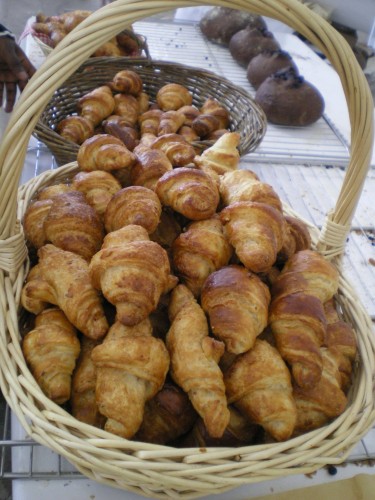 The croissant was apparently invented in Austria, but the French have certainly adopted it for breakfast on Sundays and holidays. Fancy bread rolls of all kinds (“pains au chocolat” and what we call “Danish pastries”...) are called “viennoiseries”. This word comes from Vienna, the capital of Austria where Louis XVI’s wife, Marie-Antoinette, was born.
May 16th is the feast day of Saint Honoré, the patron saint of bakers. Saint Honoré also gave his name to a cream cake made with choux pastry.
Here are some well-known expressions involving bread:
Avoir du pain sur la planche : to have a lot of work to do
Etre dans le pétrin : to be in a real fix.
Manger son pain blanc : to do something the easy way (literally “to eat white bread”. So, if you get into difficulties, these are referred to as “pain noir”, black bread.)
Watch out: the expression “mener quelqu’un à la baguette” , has nothing whatsoever to do with bread. “Baguette” can also mean a stick or a music conductor’s baton, so this means to rule somebody with a rod of iron.