
Content:
Sea
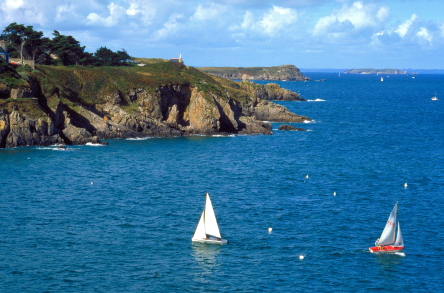 The sea, beaches and sand ... all make you think of holidays but also of the coast and harbours …
France has coastlines on the Mediterranean Sea, the English Channel, the North Sea and the Atlantic Ocean in between. Altogether, there are 5,500 km of coast with islands scattered along it. Each stretch of coast has its own geographical or poetic name: Côte d'Emeraude, Côte d’Azur (the Azure-Blue Coast), Côte d’Opale (Opal Coast), Côte d’Argent (Silver Coast), Côte fleurie (Floral Coast), etc... Most of the beaches are publicly owned and open to all free of charge. The harbours may be marinas for people who like sailing, or fishing ports or commercial docks which make a big contribution to the French economy.
Sea bathing, which was very fashionable in England, became popular in France when the first paid holidays were introduced in 1936. The beaches of Le Touquet, Biarritz and Deauville, which had rail links with Paris, were the first to see Parisian holidaymakers.
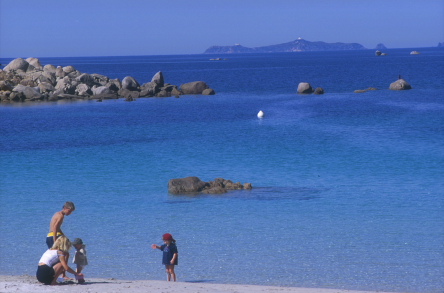 Seaside holidays are the kind French people prefer. They can choose between beaches with fine sand or round pebbles. The immense beaches in the North and West are loved by kite fliers and sand yachting enthusiasts. The big tides in the Channel attract anglers. Expert surfers prefer the huge breakers of the rough Atlantic Ocean. And the warm sandy Mediterranean beaches are so popular that you sometimes can’t find a space anywhere to put your towel down.
You no longer have to take the ferry to cross the Channel. The Channel Tunnel under the sea was opened on May 6th 1994 by the Queen of England and François Mitterrand, the then President of the French Republic. It provides a rail link between France and England carrying cars, buses and lorries, as well as the Eurostar high-speed passenger train.