
Content:
The Tour de Francereturn
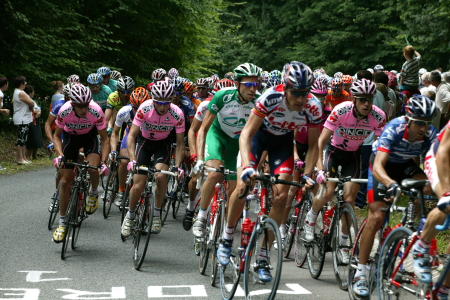
The French nickname for the Tour de France is “La grande boucle”, meaning “the big loop”. Since 1903, the best cyclists in the world have met in July in France, to cover about 3,000 km (nearly 2,000 miles) on their racing bikes.
This sporting occasion is a good excuse for a big party sponsored by advertisers. This is organised by the “Caravane du Tour”, the publicity cars and trailers which drive past and get everyone excited before the cyclists arrive. Every year the Tour de France is the sporting event which attracts the most attention from television channels worldwide. The tour starts in a different town each year but always ends in Paris on the Champs Elysées, which on that day is definitely the most famous avenue in the world.
The Tour de France is happy to take in neighbouring European countries and in 2004 it started in Liège in Belgium. On July 7th 2007 it started in London.
Yellow, green, polka-dot ... these are the coloured jerseys most prized by competitors, and which their supporters want to see them wearing. Yellow was the page colour of the magazine, L’Auto, which organized the first race. The yellow jersey (“maillot jaune”) is worn by the overall leader in the “classement général”, the rider with the shortest total time so far. The green jersey (maillot vert) is awarded for sprint points gained by your position at the end of each stage, in time trials or in sprints over specified parts of the route. As for the polka dot jersey (white with red spots), this goes to the king of the mountains and is calculated by points awarded to the first riders at the top of designated hills and mountains: the Alps, and the Pyrenees have the most difficult climbs but the Vosges, Jura and Auvergne can also make your legs ache.
Unfortunately, the extreme demands made on riders to perform well have led to malpractices such as drug taking. Compulsory medical tests have shown that some great champions used illegal drugs. The organisers of the Tour need to ensure that the sport’s rules are obeyed.
Bicycles have inspired some colourful expressions. Do you know what the following mean?
- Avoir un petit vélo dans la tête: to be slightly mad. (“To have a little bicycle in your head”).
- Avoir le nez dans le guidon: to be very focused on your work without being able to see the end of it (Literally, “To have your nose on the handlebars” but meaning roughly the same as “To be unable to see the wood for the trees”.)
- Pédaler dans la choucroute: to be getting nowhere, to be pedalling on the spot. (“To be pedalling in sauerkraut.”)
- Perdre les pédales: to be unable to understand what is happening. (“To let your feet slip off the pedals.”)
- Mettre la pédale douce: to soft-pedal/to avoid saying a lot about something unpleasant (“To use the soft pedal” – referring to the piano, not bicycles this time.)